On organic farms we are required to have a "Buffer Zone" which is a strip of land between your organic fields and your neighbors (or your own ) non-organic fields. The organic standards do not state a specific width for this buffer zone but they will tell you that approximately 25 feet is adequate in most situations.
For example, if my non-organic neighbor owned a conventional farm with 3000 cows, yes we do have some that large in Illinois, my Buffer Zone would need to be wider in order to filter out the chemicals used on that huge farm which might drain into my organic fields. (I heard that. One more crack about the width of my personal buffer zone and you will be promptly removed from my followers list)
 |
Our milking herd on pasture Oct 4, 2011. One of the reasons our
raw milk tastes like melted ice cream |
But our neighbor farmer used to be organic himself so those prohibited substances draining from his field towards ours, is minimal and well filtered by the 25 foot wide strip of land. This buffer zone can not be certified organic however, so any grass on it cannot be used to pasture our herd nor can it be cut and baled for winter feeding EXCEPT to our non-organic animals.
 |
| Buffer Zone Bales of Hay ready for Barn Segregation |
Wait ! What ? How can we have non-organic animals on an organic farm ? Well, we do because a few of our animals are never raised to provide products to others. So when we fill out our organic application we just list which animals we want certified organic and which we do not. Take Doolin for example, our goofy Equus Asinus, (Oh man, I think I just stumbled across a new nickname for some of our more stubborn family members.) that hunk of hide will never be made into jerky for our farm store, even though I have threatened him with that end result a few times. HE can eat buffer zone hay as can his two other horsey friends.
 |
I call this "Green Hay Against Blue Sky"
an original Midlife Farmwife Composition
8x10 prints just $39.95 includes shipping |
So the buffer zone hay is baled and stacked on a rack which must be blown clean of all non-organic hay left over from the last person who used the hay rack. This "blowing clean" must be documented on our Cleaning Log. (Those of you mulling around inappropriate comments involving the phrase "blowing clean"...need to pick up the phone, your High School is calling.) This hay is then stored in our barn AWAY from any organic hay. This buffer zone hay must be labeled as such so it does not get accidentally fed to our organic cows, steers and pigs.
 |
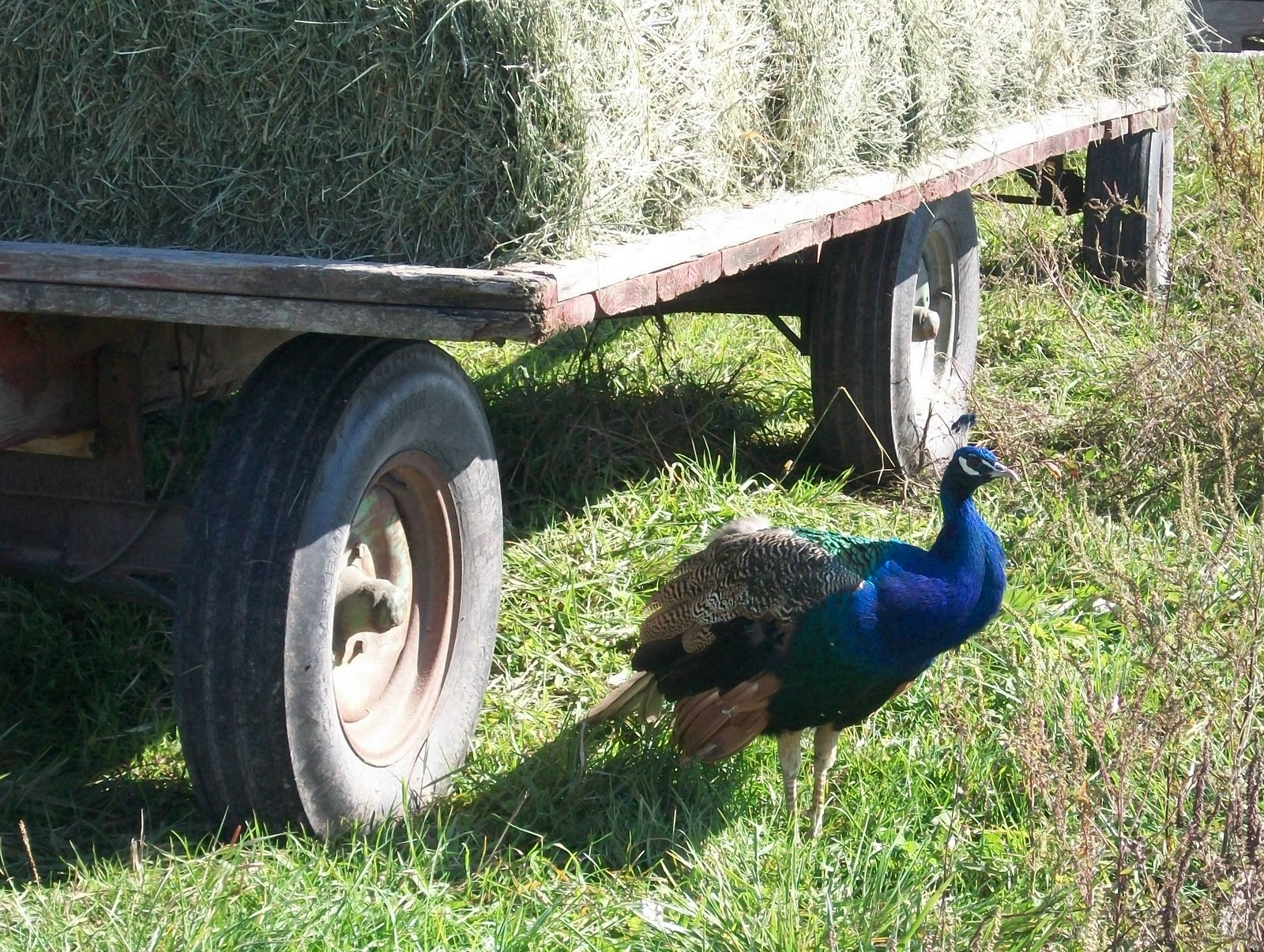
I call this "Prairie Shame"
Male Peacock loses all tail feathers at end of season.
Feels as ugly as hay
8 x10 print On sale for just $ 39.90 includes shipping |
So once again the complexities of organic certification made a little clearer. I hope